Module 1: Fundamentals
Before you can effectively operate timing equipment on race day, you need to understand the key concepts and terminology used in RaceDay Scoring.
What Is RaceDay Scoring?
RaceDay Scoring is timing software that:
-
Captures times from RFID chip readers (like the Time Machine)
-
Associates those times with registered participants
-
Calculates results and rankings
-
Publishes results for participants and spectators
Key Terminology
Understanding these terms is essential for race day operations.
Streams
A Stream is a connection to a source of timing data. Think of it as a "pipe" that brings timing reads into RaceDay Scoring.
|
Each Time Machine reader has its own IP address and requires its own Stream in RaceDay Scoring. |
Timing Locations
A Timing Location is a physical place where times are captured:
-
Start - Where the race begins
-
Finish - Where the race ends
-
Split - Intermediate checkpoints (for longer races)
Each Timing Location has one or more Streams assigned to it.
Reads
A Read is a single chip detection event. When a participant crosses the timing line, the RFID reader detects their chip and creates a Read containing:
-
Chip ID (unique identifier on the timing chip)
-
Timestamp (when the chip was detected)
-
Reader IP address (which reader detected it)
Raw vs Scored Reads
Understanding the difference between Raw Reads and Scored Reads is important for troubleshooting.
Raw Reads
Raw Reads are every chip detection recorded by the reader, unfiltered. They include:
-
Duplicates - Multiple reads when a participant lingers in the antenna field
-
Used Reads - Reads that will be included in scoring
-
Unused Reads - Reads that are excluded from scoring
A single participant might generate many Raw Reads if they linger in the antenna field, cross multiple times, or trigger the reader at different points.
Used vs Unused Reads
Within Raw Reads, RaceDay Scoring classifies each read as Used or Unused:
| Classification | Meaning |
|---|---|
Used |
Read qualifies for scoring based on timing location rules |
Unused |
Read is excluded from scoring |
Reads are marked Unused when they:
-
Occur before the start of the Scored Event
-
Exceed the maximum configured occurrences for that location
-
Are duplicate reads within the gap factor window
-
Fall outside configured time filters
Scored Reads
Scored Reads only include Used Reads that have been:
-
Matched to a registered participant
-
Validated against timing location rules
-
Selected according to the read selection criteria (first, last, etc.)
| Raw Reads | Scored Reads |
|---|---|
Every chip detection recorded |
Only Used reads matched to participants |
Includes duplicates and unused reads |
Filtered and deduplicated |
Used for troubleshooting |
Used for official results |
|
When a participant reports a missing time, check Raw Reads first. If the read exists but is marked Unused, the issue is with event configuration or timing, not the equipment. |
Chip Timing vs Gun Time
Two timing methods you should understand:
Gun Time
-
Starts when the race officially begins (the "gun" goes off)
-
All participants share the same start time
-
Traditional method, used for official results in many races
-
Common in mass-start running events and road cycling races
Chip Time
-
Starts when each participant crosses the start line
-
Each participant has an individual start time
-
Essential for events where participants start at different times
Time Trial Example
Time trials are a perfect example of chip timing. In a cycling time trial:
-
Riders start individually at intervals (e.g., every 30 seconds or 1 minute)
-
Each rider’s chip is read when they cross the start line
-
Each rider’s chip is read again when they cross the finish line
-
The rider’s time is calculated as: Finish Time − Start Time
This means two riders who both take exactly 25 minutes to complete the course will have the same chip time, even though they started 10 minutes apart.
| Rider | Start Read | Finish Read | Chip Time |
|---|---|---|---|
Alice |
09:00:00 |
09:25:00 |
25:00 |
Bob |
09:10:00 |
09:35:00 |
25:00 |
Both riders have identical chip times because each is measured from their own start.
|
RaceDay Scoring can calculate both gun time and chip time. The race director decides which to use for official results. For time trials, chip time is always used. |
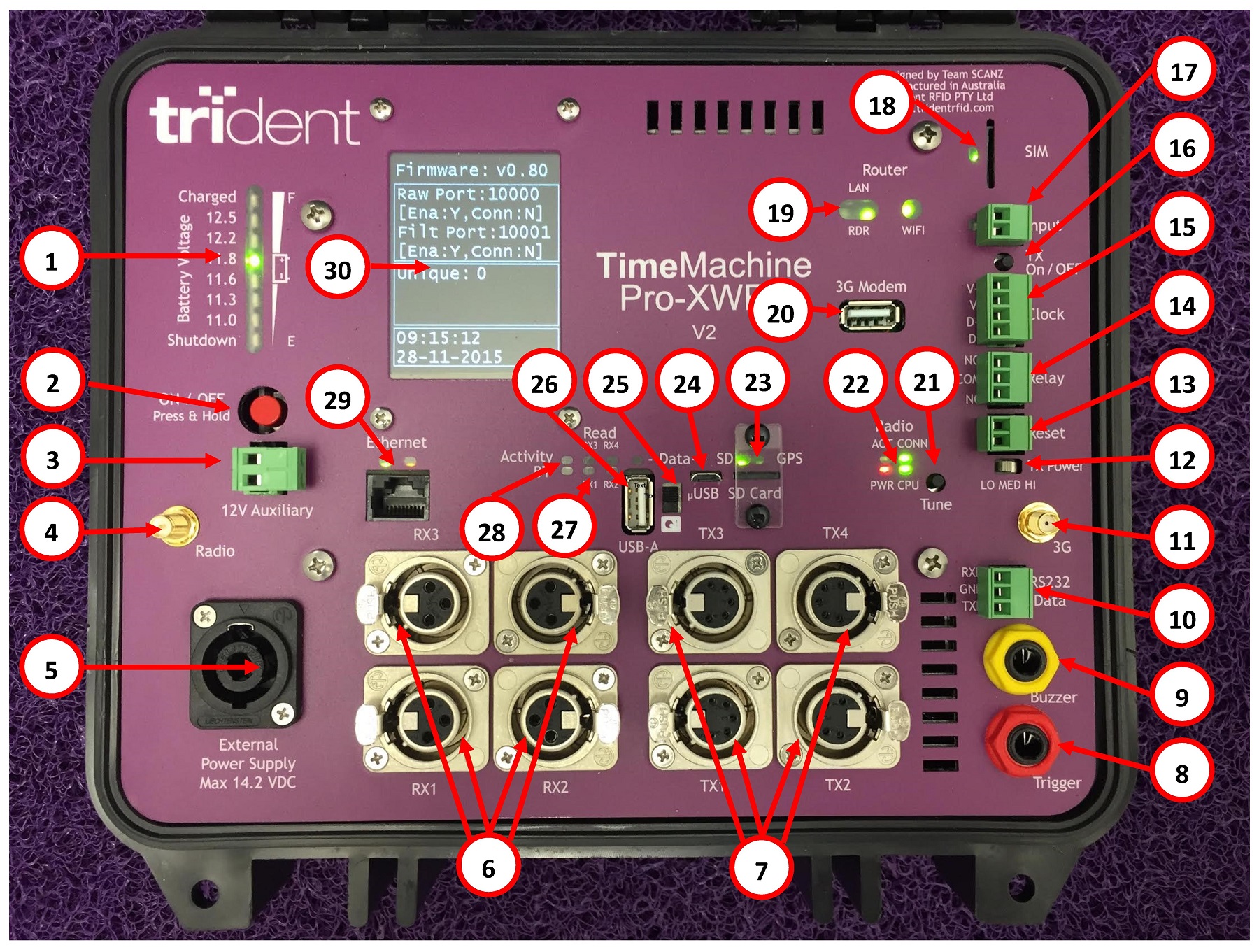
The Time Machine V3
The Time Machine V3 is an RFID reader manufactured by TridentRFID. It detects timing chips as participants cross the timing line. The antennas can be positioned as side antennas alongside the course, or as overhead antennas mounted on a truss or arch.
What You Need to Know
For race day operations, focus on:
-
Status LCD - Shows network, logging, and transmit status
-
Tag Read Activity Indicators - Flash when chips are detected
-
Receiver Status Indicators - Show the antennas are receiving signals
For detailed hardware information, see Time Machine Guide.